
How standardized scrub programs improve patient satisfaction, boost staff morale, and can be implemented with less time and cost than you think.
95%
of patients rated solid navy scrubs as most professional
55%
of patients could not identify who entered their room
65%
$67.5K
Walk into almost any hospital in the country and you'll encounter a sea of scrubs - every color, cut and pattern imaginable.
- Cartoon prints
- Holiday themes
- Bold patterns
Research consistently shows that many patients struggle to identify who is caring for them. They can't tell a registered nurse from a nursing assistant, or a respiratory therapist from a lab technician. In high-stress moments — which is to say, most moments in a hospital — that confusion erodes trust. And trust, as anyone in healthcare knows, is the foundation of a positive patient experience.
That's where a structured uniform program — often called a color-by-discipline or employee apparel program — comes in. And the evidence for implementing one is stronger than many healthcare administrators realize.
"The first impression we give patients and visitors is determined not only by our tone and expertise, but also by our appearance and demeanor."
What Is a Uniform Program, and What Types Exist?
Healthcare uniform programs exist on a spectrum. At the most basic level, a dress code policy simply defines what employees may or may not wear. At the more structured end, a color-by-discipline program assigns specific scrub colors to each role: registered nurses in one color, nursing assistants in another, pharmacy staff in a third, and so on.
| PROGRAM TYPE | WHAT IT LOOKS LIKE | BEST FOR |
| Dress code policy only | Written guidelines on acceptable attire; no assigned colors | Organizations beginning the conversation |
| Standardized style program | All staff wear the same brand/style; colors may vary by dept | Brand consistency + cost control |
| Color-by-discipline program | Each clinical role has an assigned color; embroidered role titles | Patient identification + staff pride |
| Fully managed EAP | Vendor manages selection, ordering, fitting events, allowances, and reporting | Institutions that want turnkey implementation with minimal internal burden |
The most impactful programs combine color-coding with embroidered company logo and role identifiers — such as "Registered Nurse" on the chest — so patients can confirm both the color and the title of the person walking through their door.
Why It Matters: The Patient Experience Connection
Evidence-based practice research at Geisinger Medical Center in Pennsylvania surveyed 400 patients across inpatient and outpatient settings to understand what nursing attire communicated to them. The results were striking. A significant majority of patients felt that nurses looked most professional when wearing the same uniform, and 95% rated solid navy scrubs as the most professional choice. Nearly three-quarters agreed that uniform consistency helped them feel more confident in their care.
More telling was what patients said about role identification. Over half reported that they often could not identify who was entering their room or what department that person worked in. In a setting where clear communication and trust are paramount, this ambiguity has real consequences.
Studies using the Nurse Image Scale found that patients associate professional appearance with clinical competence, knowledge, and confidence. One research team found that nurses wearing solid scrubs were rated significantly more skilled than those in printed or t-shirt attire — by patients, fellow nurses, students, and faculty alike. Appearance is not superficial. It is a form of nonverbal communication that shapes every interaction before a single word is spoken.
"Patients and family members find the color coding of staff helpful in easily being able to identify the care provider. The professional pride among our staff is palpable."
With HCAHPS scores and patient satisfaction increasingly tied to reimbursement, the question isn't whether this matters — it's whether your institution can afford not to address it.
The Morale Dividend
Beyond patient perception, there's a compelling internal case for uniform programs: they improve employee morale. When staff are outfitted consistently and professionally — with quality garments that fit well and reflect their role with dignity — they tend to report a stronger sense of team identity and professional pride.
At VCU Health System, nurses who initially resisted the change later described a palpable shift in how they carried themselves. Managers noted that staff hold each other accountable to the standard because they feel invested in it. A well-designed program doesn't strip away individuality — it channels it, creating space for role pride while establishing shared expectations.
Poorly fitting or low-quality uniforms, conversely, can undermine morale before a program even gets started. This is why fit, quality, and employee input matter as much as the policy itself.
What to Consider Before You Begin
| Role mapping | Define which disciplines will be color-coded before selecting colors to avoid overlap or patient confusion. |
| Employee input | Staff buy-in improves compliance. Simple surveys on color preferences and style options go a long way. |
| Garment standards | Anti-microbial fabric, proper fit range, maternity options, and embroidery placement all require attention. |
| Special populations | Pediatric and maternal health units may require modified guidelines based on patient preference research. |
| Budget model | Typical programs allocate 3-4 sets per full-time employee. Per-employee allowances simplify accounting. |
| Compliance tracking | Plan for new hires, leaves of absence, transfers, and ongoing reordering. Reporting tools are essential. |
One often overlooked consideration: a single health system may have dozens of different dress code policies across departments and campuses. Geisinger Medical Center discovered 70 discrete dress code policies when they began their standardization effort. Consolidating these into a coherent system-wide program requires thoughtful governance — but the operational clarity on the other side is well worth it.
How to Get Started
- Form an internal task force.
Include representatives from nursing, HR, finance, and department leadership. Designate a program champion with the authority to make decisions and drive adoption. - Survey your staff and patients.
Gather data on color preferences, style needs, and concerns. Evidence-based programs earn more buy-in because staff feel heard. - Define your color-by-discipline schema.
Map colors to roles clearly — RNs, LPNs, nursing assistants, pharmacy, radiology, etc. Consider embroidery options for role titles and your hospital logo. - Select a vendor partner.
Look for healthcare-specific experience, fitting event support, a customized online ordering store, employee allowance management, and real-time reporting capabilities. - Plan a phased rollout.
Stage ordering windows by department, hold fitting events, and communicate timelines clearly and positively to staff. Sell the benefits, not just the mandate. - Launch and monitor.
Track compliance, gather patient and staff feedback, and use data to refine the program over time.
The Outsourcing Advantage
One of the most common reasons healthcare organizations delay implementing a uniform program is the perceived complexity and cost. Managing a program manually is genuinely burdensome. When each uniform order requires 2.4 hours of staff time and costs over $60 per transaction, the cumulative load on HR and operations teams is significant.
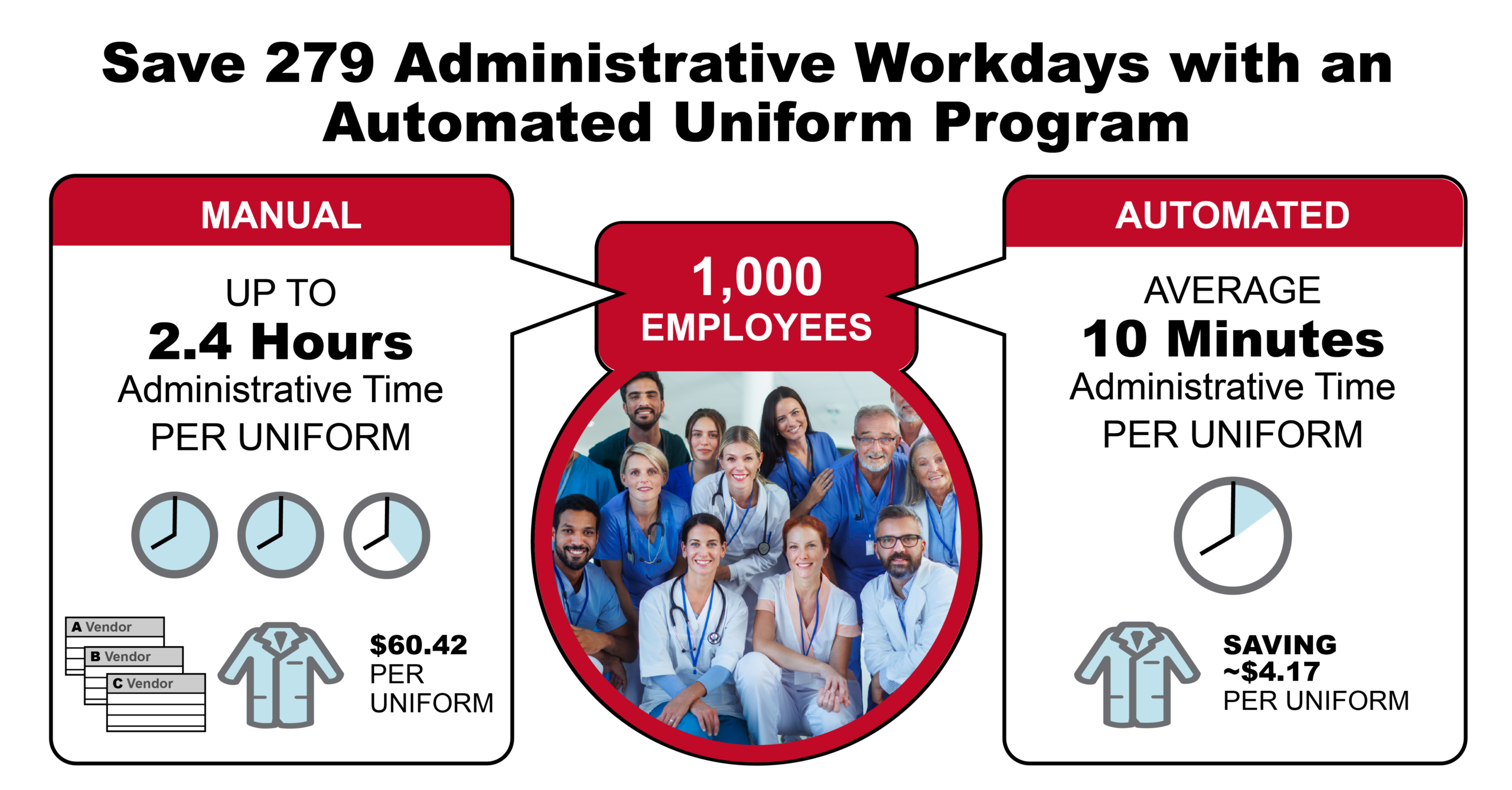
With a fully managed program, the vendor handles vendor selection, online store setup, employee allowances, fitting events, HRIS integration, and delivery — directly to employee homes if preferred. Your HR and operations teams retain visibility and control through real-time dashboards, without carrying the day-to-day management burden.
The result: 30% of the top 10 hospital systems in the country have already automated their uniform ordering. The healthcare organizations that have made this shift consistently describe the change as transformative for their operations teams — not just for patients at the bedside.
"It used to take months of planning and participation on my part every year. Now I don't have to do anything. The yearly program happens seamlessly."
Ready to Build Your Program?
Mission Medical Uniforms has been building and managing fully managed Employee Apparel Programs for healthcare institutions for more than 15 years. From UCLA Health and Kaiser Permanente to community hospitals and regional health systems, Mission has helped organizations of all sizes implement color-by-discipline programs that improve patient satisfaction, strengthen staff identity, and dramatically reduce the operational burden on HR teams.