
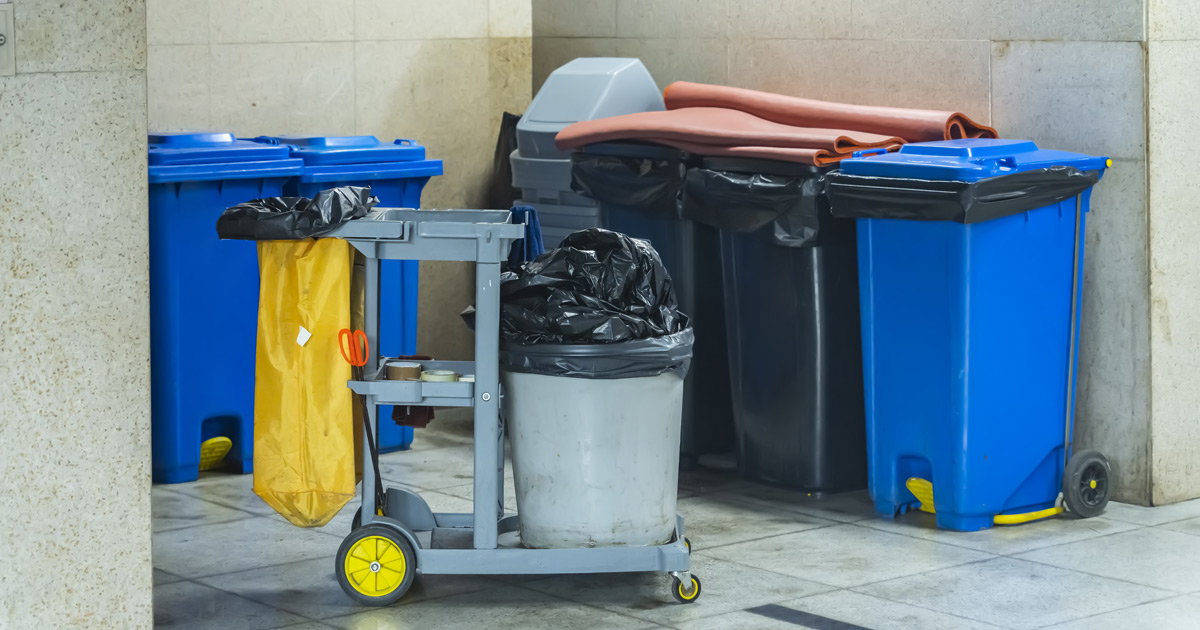
Choosing the wrong can liner is one of the most overlooked sources of operational waste in commercial facilities — and it happens every day. Bags that are too large create slack and slippage. Bags that are too small split at the seams. Use the wrong material and you're dealing with leaks, punctures, and unhappy staff.
For facility managers, purchasing directors, and business owners responsible for keeping their operations clean and cost-efficient, choosing the right can liner matters. The good news? It doesn't have to be complicated.
At Mission Linen and Uniform Services we are known for our rental services, but we also sell disposable products direct online at Buy Direct from Mission. Through our online store, Buy Direct , you can now order commercial-grade can liners in bulk — with 20% off every order and free delivery — so you never have to overpay or run short again.
We've spent over 95 years supplying businesses across California, Arizona, New Mexico, Oregon, and Texas with the business essentials they need to operate cleanly and efficiently.
This blog covers everything you need to know to choose the right can liner: size, material, seal type, and color coding. Let's make waste management one less thing to worry about.
Getting the Size Right — The Foundation of a Good Fit
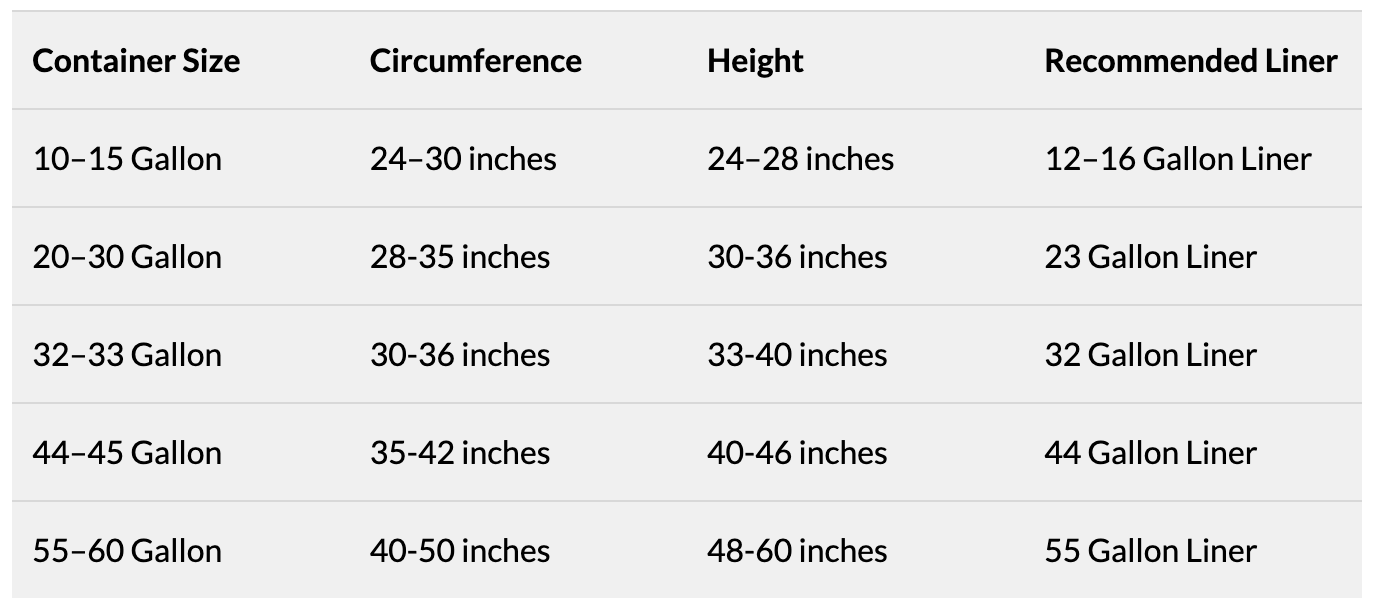
The single most common can liner mistake is choosing the wrong size. A proper-fitting liner should extend 3–4 inches over the rim of the container — enough to fold down securely, not so much that you're paying for plastic that folds uselessly into the bin.
How to Measure Your Trash Can Container
You don't need a product catalog — just a tape measure and two measurements:
- Circumference: Wrap the tape around the top of the bin, just below the lip.
- Height: Measure straight down the side from the top to the base.
The Commercial Can Liner Size Reference Chart below allows you reference your circumference and height measurements and choose the right size liner.
HDPE vs. LLDPE — Choosing the Right Can Liner Material
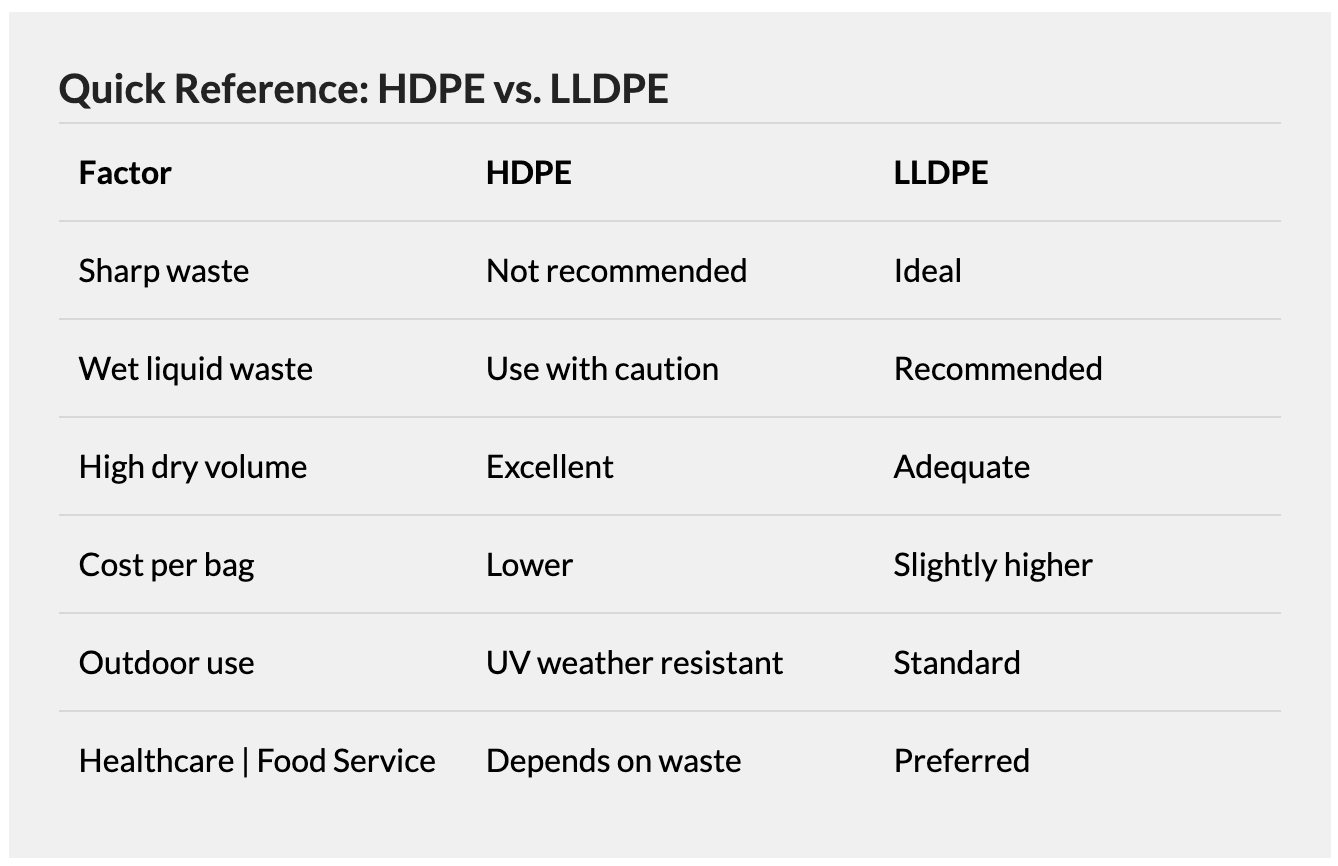
Material choice is where most businesses make their second biggest mistake. There are two primary materials used in commercial can liners: High-Density Polyethylene (HDPE) and Linear Low-Density Polyethylene (LLDPE). Each is engineered for a different type of waste environment.
High-Density Polyethylene (HDPE) Can Liners
Best for high-volume dry waste, outdoor containers, light recyclables, paper, cardboard
HDPE liners are made from a tightly bonded molecular structure that gives them impressive **strength-to-thickness ratio**. A thinner HDPE bag can often carry the same load as a thicker standard bag — which is why they're the preferred choice when cost efficiency and volume capacity are priorities.
Key advantages of HDPE liners:
- UV and weather resistant — ideal for outdoor waste receptacles
- Chemical resistant — handles exposure to cleaning agents, solvents, and oils
- Cost-effective for high-volume use— often sold in higher-count rolls at lower per-bag cost
- Handles heavy dry loads well — paper, cardboard, general office and food service dry waste
One important limitation: HDPE is a stiffer material. While that rigidity gives it strength under load, it also means **HDPE bags are more susceptible to puncture from sharp objects**. Do not use HDPE liners in environments where waste regularly contains sharp edges.
Common applications: Outdoor bins, break room and cafeteria waste, office paper recycling, food service dry waste, event and hospitality venues
Linear Low-Density Polyethylene (LLDPE) Can Liners
Best for: Sharp waste, wet environments, healthcare, food prep, industrial settings
LLDPE liners are built differently. The molecular chains in LLDPE are designed to **stretch and flex** rather than resist and hold rigid. This makes them the go-to material wherever puncture resistance and tear strength are critical.
Key advantages of LLDPE liners:
- Puncture and tear resistant — absorbs impact from sharp objects without splitting
- High elasticity— stretches under load rather than breaking
- Performs well in wet conditions — better containment for liquids and wet waste
- Strong even when overfilled — more forgiving than HDPE in demanding environments
The tradeoff: LLDPE liners are typically thicker (and therefore heavier and slightly higher cost per bag) than HDPE equivalents. However, in applications where a single leak or split bag creates a sanitation hazard or a costly cleanup, the investment pays off immediately.
Common applications: Restaurant kitchens and food prep areas, healthcare and medical facilities, industrial and manufacturing floors, janitorial carts, construction and maintenance areas
Seal Types — The Design That Determines Durability
The bottom seal of a can liner is often overlooked, but it's where most bag failures start. There are three common seal designs used in commercial liners:
Star Seal (High-Performance)
The star seal is the industry standard for commercial applications — and for good reason. Rather than folding flat at the bottom, the star seal cinches evenly from multiple points, creating a bottom that:
- Eliminates weak seam points found in flat and gusset designs
- Conforms to the shape of round, square, and irregularly shaped containers
- Distributes weight evenly across the bottom, reducing pressure on any single point
- Maximizes bag capacity by expanding to fill the container fully
For most commercial users — from healthcare facilities to hotel housekeeping to restaurant kitchens — star seal liners should be the default choice.
Gusset Seal (Flat-Folded)
Gusset seal bags fold flat, with sealed side panels (gussets) that expand when opened. They're a legacy design that works reasonably well for light, dry, non-sharp waste — such as paper, tissues, and textile waste. However, the center seam and side gussets create weak points that can fail under heavier loads or with sharp materials.
Flat Seal
The flat seal is the simplest design: two layers sealed at the bottom, like a pillowcase. It's suitable for light, dry waste in regular-shaped containers, but it does not conform well to the shape of most commercial bins and presents a higher leak risk than star seal designs.
Recommendation: For virtually all commercial environments, specify star seal liners. Reserve gusset and flat seal options only where cost reduction is critical and waste is exclusively light and dry.
Can Liner Color Coding — A Simple System That Matters
Color coding isn't just for aesthetics — in regulated industries, it's a compliance and safety requirement.
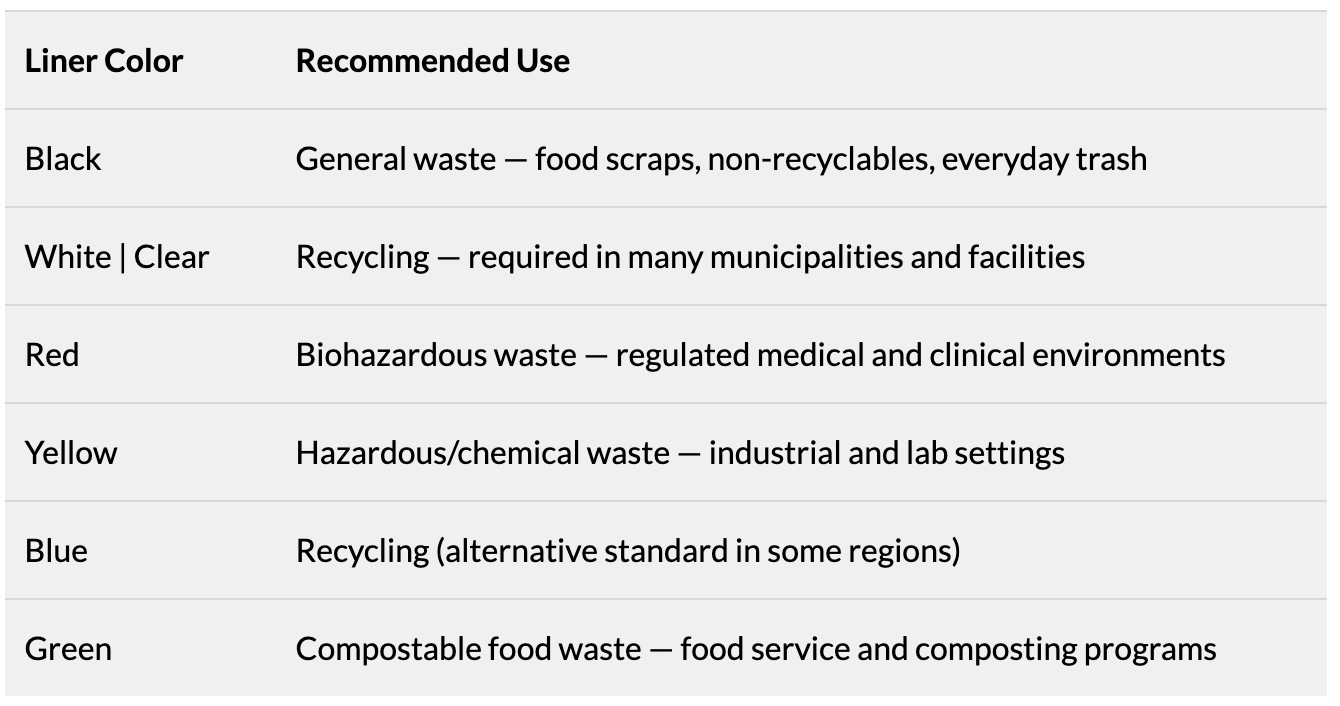
Implementing a consistent color system across your facility reduces contamination, improves compliance, and makes staff training simpler. Buy Direct from Mission offers a full range of liner colors in commercial quantities.
Buying Can Liners in Bulk — Why It's the Smarter Business Choice
For any facility that uses can liners consistently — which is essentially every commercial operation — buying in bulk is a straightforward cost and efficiency decision.
The math is simple: Per-unit costs drop significantly at commercial quantities. For a mid-size restaurant using 50–100 liners per week, even a modest per-bag savings compounds to hundreds of dollars annually. For larger operations like hotels, hospitals, or school districts, the savings scale accordingly.
Beyond cost, bulk purchasing means:
- Fewer reorder cycles and less administrative overhead
- Consistent product quality across all locations
- Reduced risk of running out at inconvenient times
Save 20% on Every Order with BuyDirect from Mission — Plus Free Delivery
BuyDirect from Mission is the online store from Mission Linen Supply — a family-owned company with over 80 years of experience supplying businesses across the Western U.S. with commercial-grade facility products.
When you shop BuyDirect, you get:
- 20% off every order, automatically — no promo codes, no minimum thresholds to chase
- Free delivery to your facility
- Top commercial brands including Boardwalk, Heritage, AccuFit, Interplast, and more
- A full selection of can liners by size, material, seal type, and color
Whether you manage a single restaurant, a multi-site healthcare network, or a regional hotel chain, Buy Direct from Mission gives you access to the same commercial products at consistent wholesale pricing — with none of the friction of traditional supply ordering.